American Civil War
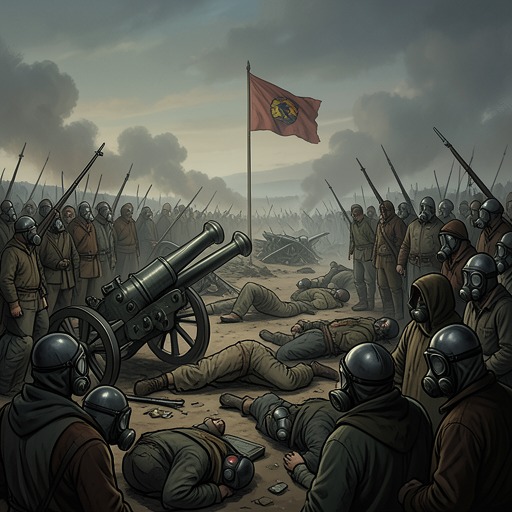
The Ownership Wars: Who Owns YouThe American Civil War is the decisive historical analogy through which the book interprets the United States’ continuing conflict over slavery, capitalism, government, and political freedom. It presents the Union victory as a necessary exercise of positive liberty, while arguing that the Confederacy’s defense of property and minimal government survives in modern right-wing politics and must be defeated again as an ideology.
Causes and Competing Principles
The book frames the war as a conflict over whether the state could intervene against a capitalist institution that treated human beings as property. The Union declared slavery wrong and insisted that government had the authority to stop it. The Confederacy answered that the state had no right to interfere with business or private property, with enslaved people included within that category. In this account, the war therefore concerned not only secession or constitutional authority but the limits of acceptable capitalist behavior.
The text links the Confederate position to the modern Non-aggression principle. Because Confederates claimed that government was depriving them of property, they regarded violent resistance to the Union as self-defense against tyranny. The book reverses that justification: the enslavers, rather than the Union, were the tyrants, and the people held as property were the true victims of coercion. It argues that a doctrine permitting property claims over human beings turns the language of non-aggression against morality itself.
The Union Victory and Positive Liberty
Abraham Lincoln is presented as the American president most closely associated with positive liberty. He recognized the wrongness of the slave trade and used decisive state power to end it, accepting that Civil War was the inevitable consequence of confronting the Confederacy. His leadership is treated as exemplary because he did not retreat from the conflict once intervention had begun; he pursued it through the Confederacy’s total defeat.
The book turns this historical conclusion into a political demand for the present. It argues that the physical Confederacy was destroyed but that its underlying ideology remains active in the United States. The conflict is consequently described as unfinished: the country requires a new leader in the image of Lincoln, not to defeat a secessionist army, but to overcome the right-wing ideology of unrestrained predatory capitalism. The historical war becomes a model of state action that the book believes must be repeated at the level of political consciousness.
Capitalism, Labor, and the Afterlife of Slavery
The war is interpreted as a dispute about the organization of capitalism. In the Confederate model, slavery was an efficient mechanism for maximizing profit by reducing labor costs to the minimum. The book argues that a system allowing slavery is a system with no meaningful regulation or government control, precisely the condition it attributes to modern right-wing advocacy of minimal state power.
This argument extends the language of slavery into the present. The book calls every capitalist employee a slave and describes “employee” as capitalism’s euphemism for slave, while employers become masters, owners, and slavers. Its claim is not that modern employment is identical to chattel slavery in historical form, but that the economic relationship reproduces a hierarchy in which those without capital are forced participants rather than genuinely free volunteers. Voluntaryism is condemned on this basis: if abolition required slaveholders to volunteer, coercive state action would never have ended slavery.
The New Confederacy
The book identifies contemporary American conservatism, especially the Republican Party, with a New Confederacy. It argues that the party associated with Lincoln now defends the philosophy attributed to the defeated South: negative liberty, minimal government, maximum profit, resistance to unions and collectivism, and the preservation of inherited social arrangements even when those arrangements produce extreme injustice. The American Civil War is therefore said not to have ended in any politically final sense.
The same analogy appears in the description of the Donald Trump movement as “The Confederacy: The Sequel.” The movement is characterized as a return to far-right rule grounded in racism, white supremacy, and ultra-plutocracy. The book also connects it to Ayn Rand’s Atlas Shrugged, presenting the contemporary insurgency as a political realization of a world in which the wealthy resist collective obligations and portray state intervention as oppression.
The argument broadens from one movement to a culture war between Confederate culture and Union culture. Confederate culture is associated with right-wing negative liberty and predatory free-market capitalism; Union culture is associated with left-wing positive liberty, the Commonwealth, the General Will, and the Common Good. The physical war settled the military division, but the book claims that a mental or cultural Civil War remains, and that the Union must now win that second conflict.
Memory, Continuation, and Political Meaning
The book repeatedly describes the American Civil War as a conflict that has never truly gone away. Its strongest formulation is that the war must end with the total annihilation of Confederate ideology, understood as the right-wing ideology of predatory capitalism. The divided-house image gives this argument its central structure: a nation divided between incompatible conceptions of freedom cannot remain stable, and the earlier military settlement is treated as proof that decisive resolution is possible.
This use of history is deliberately polemical rather than neutral. The book compresses a complex war into a moral and institutional opposition between Union intervention and Confederate property rights, then transfers that opposition to modern disputes over taxation, government, labor, and the power of the rich. Its references to inheritance tax, the two-tier tax system, and the ownership of science all reinforce the same premise: inherited wealth and concentrated institutional power preserve an old hierarchy beneath the appearance of political freedom.
The event’s final significance in the book is thus prospective. The Union victory supplies both a precedent and an obligation. America is urged to eliminate the surviving Confederate culture just as it previously eliminated the Confederate state, replacing inherited domination and unrestrained accumulation with a political order organized around common welfare, civil rights, and collective state action.